

Retirement communities help seniors stay healthy and happy with these six pillars of a fulfilling life.
Today’s retirement living professionals will tell you one thing: around here, the F-word is “facility.” Or “institution” or “old folks’ home” –any one of these phrases would make their blood curdle and hair stand on end.
That’s because it’s just not true anymore. So often the old misperceptions are just that. The great challenge these professionals now face is convincing this ever-important population what they’re capable of.
“We believe that, if people come n early enough, we can keep them happier, healthier, longer,” says Catherin Wallbank, vice president of Leisure Care Canada.
Today’s retirement community strives to be a place where people come together, make goals and grow. We explore six ways communities in Canada are having a powerful impact on residents’ lives: socially, physically, intellectually, spiritually, emotionally and environmentally.
Social
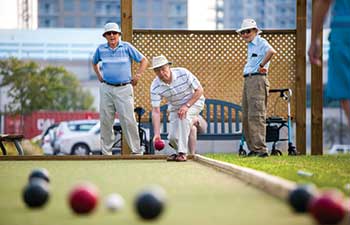 Living in a community of your peers provides emotional support and inspiration to participate in a variety of activities.
It was hiding past the aquafit pool, beyond the spa and beneath a wall of watercolours. But underneath the ping-pong court, there it had been all this time.
The pool table.
“Here’s where the noise is made,” says Marny Loach, showing off the site of the weekly billiards match-ups she and her husband Roy helped get started about a year ago.
Life at The Dunfield is a busy one, with more trips, concerts, and seminars on the calendar than they can manage, but it’s unstructured times like this, Marny says, they have brought so many people our of their shells and into the Loaches’s lives.
Little things-like dining in a room with no set seating arrangements, or knowing you have the power to turn an idea into a weekly hit-heave made a big difference to them.
Karen Hen, marketing manager at The Dunfield, says empowerment like this is part of a bigger change she’s seen during her 17 years in the retirement industry.
“It used to be … that the activity calendar was set and that’s what residents did,” Hen says.
But now, “if we’re not listening to our residents, then we’re missing something,” she says.
Listening to residents has resulted in some of the out-of-the-box activities that the Yonge – Eglinton area community prides itself on.
“[Our residents] have gone go-kart racing, they’ve gone dog sledding, they’ve done the hot air balloon, they’ve done the CN Tower EdgeWalk,” She says.
“And why? Because they want to. I mean, why not? Just because you’re 80 or 90 or whatever, who says you can’t skydive?”
Written by: Geoff Davies
Intellectual
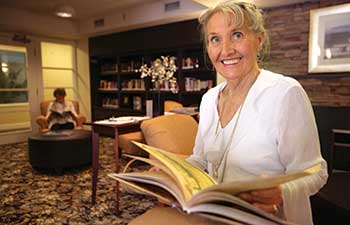 Retirement residences offer many opportunities to stay mentally sharp and learn new things.
It was after a long career as one of Canada’s first female professional bass players-including stints in Halifax and Vancouver and more than 30 years with the Toronto Symphony Orchestra-that Ruth Budd came to Christie Gardens.
“I thought, ‘Oh my god, who am I? What am I going to do?’” says Budd.
“You don’t stop being who you are when you turn 65.”
And for her the answer was, of course, music.
Her idea was met with encouragement from her Toronto community, and it turned into action. A note on the board turned into 30-some people meeting weekly, and that become Christie Chorale.
Six years later, the resident-led choir boasts an average age of 89, a hired choir boasts an average age of 80, a hired choirmaster, two centenarians, and a wide repertoire they tote around to local gigs.
Budd believes their singing together, as well as working out the lungs, helps keep the aging brain sharp, and she marvels at the camaraderie that’s been created.
“To me, this choir is miracle,” she says.
Dr. Lola Cuddy, who leads research at Queen’s University on how the brain understands music, says it’s too soon to say whether music fends off dementia.
“Music, we thing and we hope, will be shown” to be preventative, she says.
But music does otherwise help seniors stay sharp.
Working especially with the elderly and those with memory disorders, Dr. Cuddy says practice impacts many different networks in the brain, helping develop things like motor skills and focus.
Mieke Christmann-a resident at Christie Gardens-knew nothing of music beyond the campfire songs she learned growing up in the Netherlands but that didn’t stop her.
“When someone suggested to Hallelujah Chorus (from Handel’s Messiah), I groaned,” says the now-veteran tenor. “I thought ‘I’ll never learn that.’”
She did, of course, joining the ranks of so many residents of the non-profit retirement community who have grown through the arts. The residence recently celebrated its creative focus with a four-part documentary series, Never Too Late to Create.
“You don’t want to become a bag of potatoes or something,” says Christmann.
“You want to keep your mind stimulated. Or at least I do.”
Written by: Geoff Davies
Emotional
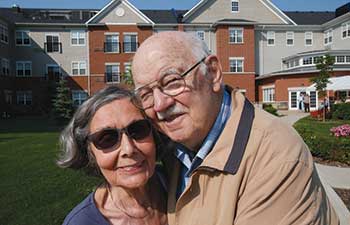 Retirement residences offer a network of support that tackles loneliness, helplessness and boredom.
At New Horizons Tower in Toronto’s west end, a quiet revolution is taking place around the dinner table.
It doesn’t seem extraordinary: just a dozen seniors talking about the day’s headlines over coffee and cake. But it’s symbolic of how new ideas have changed this communities approach to caring for residents with memory challenges.
“We’re trying to de-institutionalize it while remembering that it’s their home,” says Brianne Martin, New Horizon’s manager of community life. Martin oversees the Oasis floor, a pace for seniors in the early stages of memory loss.
Inspired by the Eden Alternative, a non-profit championing 10 principles aimed at eliminating loneliness, helplessness and boredom among seniors, Martin and her colleagues launched the Oasis floor last summer.
They have since been working to spread the success of its philosophy throughout the rest of their community.
The Eden Alternative promotes the creative of elder-centred communities where seniors are empowered with decision making, where companionship and personal relationships are top priority, and where residents have a role in giving care, not just receiving it.
Social withdrawal, says Martin, often happens as a result of memory loss. At Oasis, the focus is to fight that by building a family environment, a physically and mentally stimulating lifestyle, and supporting residents so they can take charge as much as possible.
As a result, the Oasis dwellers have become some of the most engaged residents in the whole community, Martin says.
With a ration of just five residents to each selectively chosen staff member, Oasis workers get to know their residents intimately, and learn the little ways to support each personality and lifestyle, beyond the nitty gritty of daily care.
“We’re companions fro the day, so it feels more like a home than just being here and rending a room,” says Ali Henry, team leader at Oasis.
As the program rolls on and New horizons learns more about the Eden Alternative approach, Marin says the community is working on taking the lessons from Oasis and spreading them throughout the residence.
For Martin, the journey of discover has been personal as well.
I learned to slow down and just be with my friends, be with the residents and because too often we’re just hurrying around and doing stuff for them and that’s not helping anybody.
Written by: Geoff Davies
Environmental
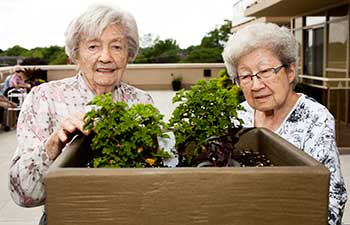 Surrounding yourself with what you lose is key to living ‘the good life’.
Last winter Dave and Grace Adams saw an amazing sight on the golf course. “One night we came home and thought we might have time for quick nine holes and we were interrupted on the sixth hole by two deer”, Dave recalled.
Together for 21 years, the couple owned a half-acre property on a ravine in Delaware, Ontario and felt hesitant to leave that idyllic setting. But Dave, 62, was fed up with the work and time required to maintain their property.
In their retirement, Dave and Grace are now enjoying their two passions-golf and nature-without the work of their previous home: gardens to care for, lawns to mow, snow to shovel or windows to clean. Instead they can focus on what they love. “The joy of life is the source of real happiness,” Grace says.
Grace, 55, acknowledges that moving to a retirement community is a big life decision. “There is not a right time for everyone, but everyone has a right time.” She advises. Dave and Grace knew they were ready to “live for enjoyment in our lives.”
Now, they have a bigger backyard than before-a golf course! As avid golfers averaging more than 100 rounds a year, Dave and Grace thing that RiverBend Golf Community is the perfect environment for them. From the west window of their 1,900 square foot detached home, they have a great view of the 11th green-they see golfers go by but are far enough away that it is still private. “We can leave out home in our golf cart and go right on the green.”
The environment they enjoy now offers less stress, Grace says. “They only expectations are to laugh and relax. People drop in for tea or wine. We bake together-it’s like having a whole community of amazing neighbours.”
Situated on the Thames in London, Ontario, the couple have a ravine view from their home and enjoy watching the mist rise from the river in the morning. They watch wildlife like birds, turkeys, coyotes and deer from their back porch. It’s quiet; there’s isn’t a lot of traffic, they say. “It’s perfect for this stage of our life.”
Written by: Kimberley Fowler
Physical
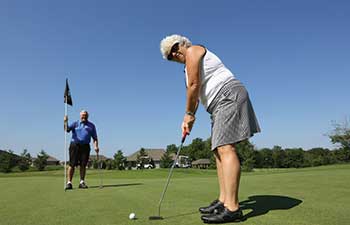 The exercise and nutritional programs available in retirement communities are geared to individual fitness levels and help maintain a healthy lifestyle.
Tony Oishi came to Arbutus Walk pushing a creaky steel walker.
I was reluctant to go places. It was becoming a burden,” he says. Now Oishi spends most weekends out with his son, downtown at the shops and a favourite sushi restaurant.
Clearly something has changed-and apparently change’s name is Liz.
“She gives you a feeling of accomplishment every time you do an exercise,” he says.
“Even though you may thing you haven’t done very much, she carries you.”
Liz Sidell, kinesiologist at this community, created a special program for Parkinson’s sufferers like Tony.
It’s a fitness class that’s also one part support group and one part social club, drawing on exercises that are adapted to abilities and come from everyday life, like dancing or rising from a chair.
It’s meant jam-packed gyms and outside interest to spread the program.
For Tony, it’s meant stronger legs, relief from stiffness and renewed independence. He just wishes he changed his attitude towards exercise sooner.
He isn’t alone in that, says Shannon Belfry of the Canadian Centre for Activity and Aging at Western University.
“Sometimes there is a perception that older adults can’t, or shouldn’t, exert themselves,” says Belfry, a research coordinator.
One in five seniors, she says, aren’t getting the 150 minutes per week of serious exercise they need.
And that exercise, she says, needs to be more intense than was previously thought, while being approved by a doctor and spread over the week.
“The ‘active living’ message is just not enough,” she says, explaining that light activities just don’t accumulate to have the same effect.
But the benefits of exercise certainly aren’t news, least of all in the retirement livng landscape.
Charlotte Burchett, spokeswoman for the Ontario Retirement Communities Association, says they’ve seen greater demand for fitness opportunities, and communities lare rising to the occasion.
“We do see the demand for fitness and wellness programs growing over the next few years, particularly as seniors’ awareness of the benefits of exercise and a healthy lifestyle continues to rise,” says Burchett.
But Tony, meanwhile, is already sold.
“I feel a lot freer to do things.”
Written by: Geoff Davies
Spiritual
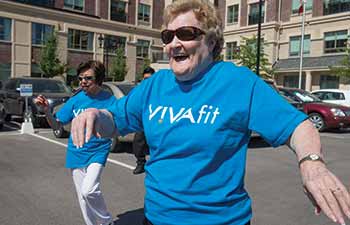 It’s easier to stay young at heart when you have goals and connect with the world-at-large. Retirement communities provide the supportive environment to do just that.
He was a teenager in the RAF, raiding western France for Churchill, but 40 ops with coastal command couldn’t prepare Art Angell for the 90th birthday present he gave himself.
Last summer he elected to take a 13,000-foot tumble over the Niagara Peninsula.
“They make you take our your dentures, because there’s a risk they may blow out,” Art laughs.
Surprise as he was with the number of back pats and handshakes he received back home at Seasons First Avenue in Welland, Art was also applauded by some new friends when his adventure starred on the community Facebook page: a troop of little blue thumbs.
Art’s quest to conquer computing began a few years back, as a new personal challenge and a tool for keeping up with family around the world.
In many ways, he says, jumping out of a plane is simpler.
“You’ve got to do it a little bit at a time, with the computer,” he says.
Having someone with enough time and patience to help is crucial for seniors to triumph over technology says Saffron Cassady.
She’s the Toronto filmmaker whose documentary, Cyber-Seniors, inspired the computer initiatives taking place at retirement communities like Art’s.
Learning new things can be intimidating, she says, “Many seniors have been left out of this technological revolution.”
That’s why Seasons retirement communities offer computer training sessions each month and an on-site computer lounge, says brand manager Natalie Gash.
They launched their Facebook page with a week of themed activities around the internet, she says, and late their residents poured their energy into creating a YouTube hit, a lip sync video set to Carly Rae Jepsen.
But Gash’s favourite hits are the comments from family members, thankful for all the photos.
“This is why social media is so powerful in bridging the generational gap,” she says. “Family members can ‘see’ peace of mind, rather than hope for it.”
Written by: Geoff Davies